Why Mixed Reality Rehabilitation Is More Accessible Than Many People Expect
For many stroke survivors and their families, the idea of using technology during rehabilitation can feel daunting. When cognitive challenges or aphasia are involved, the uncertainty grows: Will I be able to use this? Will my loved one understand it? Will it be too overwhelming? These concerns are understandable and very common.
But in practice, the people who often benefit most from NeuroVirt are those living with exactly these challenges. NeuroVirt was co-designed with patients from to adapt to a wide range of cognitive and communication needs, and to remove barriers that traditionally make rehabilitation difficult.
Reducing cognitive load so patients can focus on what matters
Anyone recovering from stroke knows how much mental effort even simple tasks can require. Traditional rehabilitation can involve multi-step instructions, written worksheets, or complex equipment, all of which can be overwhelming for someone with impairments in memory, attention, or executive function.
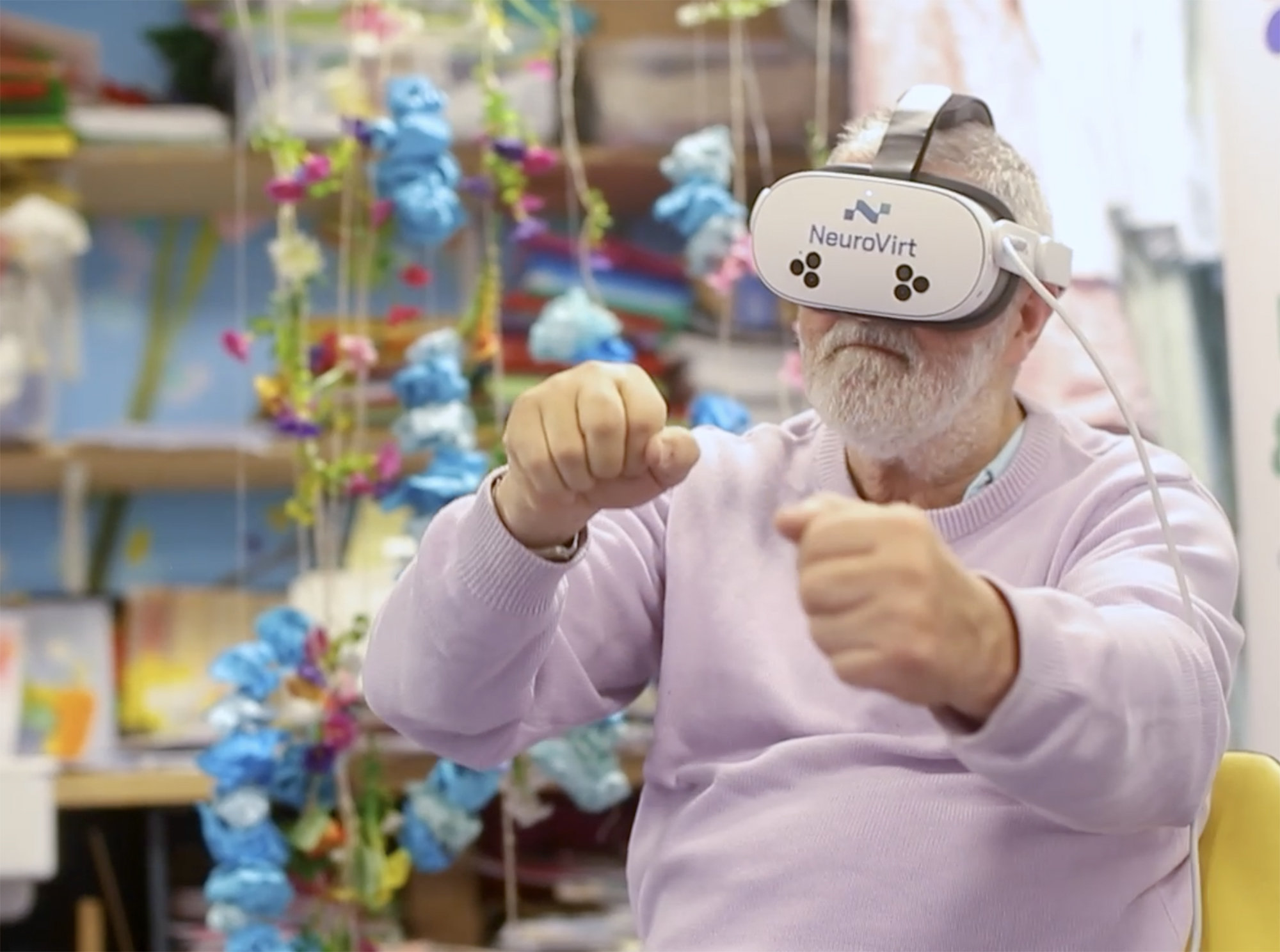
NeuroVirt takes a different approach. Inside the mixed reality environment, tasks are broken down into clear, single-step actions. Instead of long explanations, movement is demonstrated visually. Instructions appear as intuitive cues: glowing buttons, directional paths, or simple animations that guide the patient automatically as they move.
This reduction in cognitive load allows patients to engage without feeling flooded, frustrated, or left behind. For many, the simplicity brings a sense of relief: they can finally focus on practicing movement rather than decoding instructions.
Aphasia shouldn’t be a barrier to meaningful rehabilitation
Aphasia affects language - but not intelligence, motivation, or the ability to learn through action and repetition. Because NeuroVirt relies predominantly on visual and kinaesthetic interaction, patients with aphasia can participate fully even if verbal comprehension or speech is limited.
They don’t need to read detailed instructions or respond verbally. Instead, they follow visual cues and animated demonstrations that make it clear what they need to do. Clinicians often tell us that patients with aphasia appear more relaxed in mixed reality sessions, because the pressure to communicate is temporarily lifted. They can engage on their own terms, without the frustration that sometimes accompanies language-heavy tasks.
Cognitive challenges do not prevent neuroplasticity
A lingering misconception in rehabilitation is the belief that cognitive impairments limit a person’s ability to benefit from motor practice. But research shows that neuroplasticity - the brain’s ability to adapt and rewire - does not require perfect attention, memory, or language skills.
What it does require is repetition, feedback, and meaningful engagement.
NeuroVirt supports all three. The tasks encourage high numbers of repetitions without feeling monotonous. Immediate visual feedback shows patients whether their movements are successful. And the enveloping nature of mixed reality helps many people stay focused longer than they can in a traditional therapy environment.
Even patients with reduced attention spans or slow processing speed can participate effectively, because the system adapts to their pace and ability in real time.
Adapting to each patient’s needs moment by moment
One of the strengths of mixed reality rehabilitation is its ability to adjust instantly. If a patient is fatigued, unsure, or overwhelmed, NeuroVirt can reduce complexity and slow activity speed automatically.
Rather than pausing the session to reset equipment or re-explain instructions, the therapy continues seamlessly at a level that feels achievable. This keeps patients confident, successful, and engaged, which is crucial for long-term progress.
Clinicians remain central throughout the process. They guide the patient, shape the goals, and tailor the settings, using the technology to enhance their expertise rather than replace it.
Most importantly: patients enjoy it
Engagement is one of the strongest predictors of recovery potential. When therapy feels rewarding, people participate more - and more participation means more opportunities for the brain to relearn.
Many patients with cognitive or communication challenges find that mixed reality sessions feel less intimidating than traditional therapy. They can move without performance pressure. They can see their progress immediately. And they often experience moments of joy and confidence that spill over into the rest of their rehabilitation journey.
Families tell us that NeuroVirt sessions often reveal abilities, concentration, or motivation they haven’t seen in other contexts. For many, it becomes a turning point and a reminder that progress is possible, even when communication or cognition feel uncertain.
A reassuring takeaway for families and clinicians
If you or your loved one is living with cognitive impairments or aphasia after a stroke, it’s natural to wonder whether technology-based rehabilitation will be too difficult. But NeuroVirt is purposely designed so these challenges are not barriers.
With visual guidance, simplified tasks, adaptive difficulty, and clinician-led support, patients with a wide range of cognitive and communication profiles can participate meaningfully, and often more comfortably than in traditional therapy.
The goal isn’t flawless performance. It’s engagement, confidence, consistency, and creating the conditions for the brain to relearn.
And for many stroke survivors, mixed reality offers exactly that.