Explore how NeuroVirt is reshaping rehabilitation across clinical settings. Our case studies highlight real-world applications, showcasing measurable improvements in patient engagement, recovery, and therapy efficiency. Learn how therapists are using NeuroVirt to deliver targeted, personalised therapy and support meaningful patient progress and stronger service delivery- outcomes that matter in rehabilitation practice.
Dr. Eve Gregoriou founded NeuroVirt during their PhD in Clinical & Movement Neurosciences at University College London after witnessing how overloaded healthcare systems meant that stroke survivors didn't have access to the dose and intensity of care required for full recovery potential.
Traditional rehabilitation often felt too slow and repetitive — patients were under-engaged, assessments overly manual, and rehab technology too static to adapt to individual progress. Determined to change that, they combined their clinical research background in neurotechnologies with XR and AI to build a rehabilitation platform that’s motivating, adaptive, and data-driven. Their goal has always been to provide access to care and help people move better, more often, and with more confidence — whether in clinic or at home — while giving clinicians tools to see real progress, not guesses.
Overview: Post-stroke individual undertook an intensive, independent rehabilitation program at home.
Duration: 6 weeks
Phase 1: Intensive physical therapy and occupational therapy completed twice a week for six weeks with home exercises provided for an intensive program.
Phase 2: Intensive rehabilitation using NeuroVirt for two hours a day for six weeks. Home exercises completed in addition to this.Intermittent clinical support was provided and standard clinical outcomes completed fortnightly (including Fugl-Meyer, Stroke Impact Scale score, Grip strength).
The individual adhered 100% to the NeuroVirt program.Clinical movement outcomes showed 30% better improvement across, including an increase in grip strength by 65% with NeuroVirt vs. usual care. Intrinsic motivation inventory score was 29% greater with NeuroVirt than under usual care.Intensive rehabilitation time/dose increased by 200%
Increasing Rehabilitation Intensity Without Increasing Staffing:
A large NHS subacute neurorehabilitation unit in the South East of England explored the use of NeuroVirt during a clinical trial to increase rehabilitation intensity for patients with complex neurological rehabilitation needs.
NeuroVirt was introduced within supervised and semi-supervised rehabilitation sessions. Patients used multiple headsets to complete prescribed rehabilitation activities, with clinicians using the web app to provide feedback and review changes in movement over time.The team explored whether the system could support additional repetitive practice without increasing staffing requirements, while remaining practical to implement within the clinical environment.
• NeuroVirt provided an opportunity to increase rehabilitation intensity without additional staffing.
• Patients completed high volumes of repetitive movement, with one patient completing hundreds of repetitions in a session.
• Movement feedback in the web app enabled patients and clinicians to visualise changes in upper-limb movement over time.
• Multiple headsets allowed several patients to practise simultaneously during semi-supervised sessions.
• Setup took approximately two minutes, supporting straightforward integration into existing sessions.
• Patients across a wide age range, including people in their 90s, were able to use and enjoy the system.
• The team reported positive patient feedback, including increased motivation to attend the gym and participate in rehabilitation.
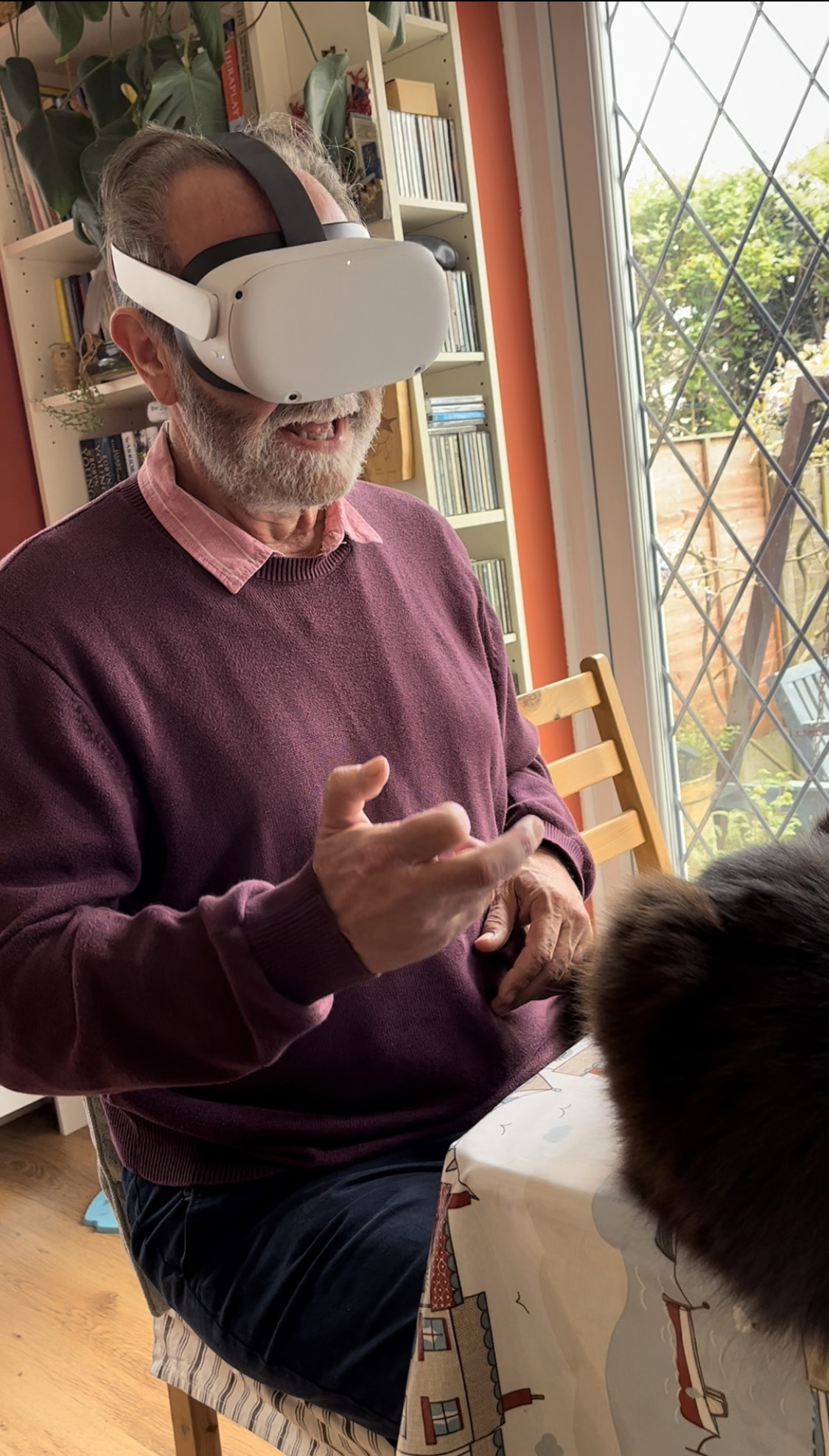
Richard participated in our inaugural case study as our very first patient. During his sessions, he developed a technique for donning the headset with one hand, a method we now refer to as “the Richard Method,” which has since become a core part of our training.
He did 72 additional hours of therapy to his usual care at 14x the intensity of therapy per session than usual care.
You can just very easily access the game, get on with it, know what you're doing, and I think just enjoy it as well. And I think this game seems to tick all the boxes for me.
-RICHARD, Stroke Survivor


